Can it get any easier ?

Over the next several weeks we will be demonstrating just how easy it is to use Zenler Studio for authoring e-Learning courses. One of the key areas where is converting existing content from word, PDF’s, and PowerPoint to an e-Learning platform. Since Zenler publishes to any LMS that is SCORM or AICCs compliant. These little “How Too” sessions with Zenler Studio will not be long because this is really easy. So take a quick look and we’ll show over the next few weeks how easy creating e-Learning courses can be.

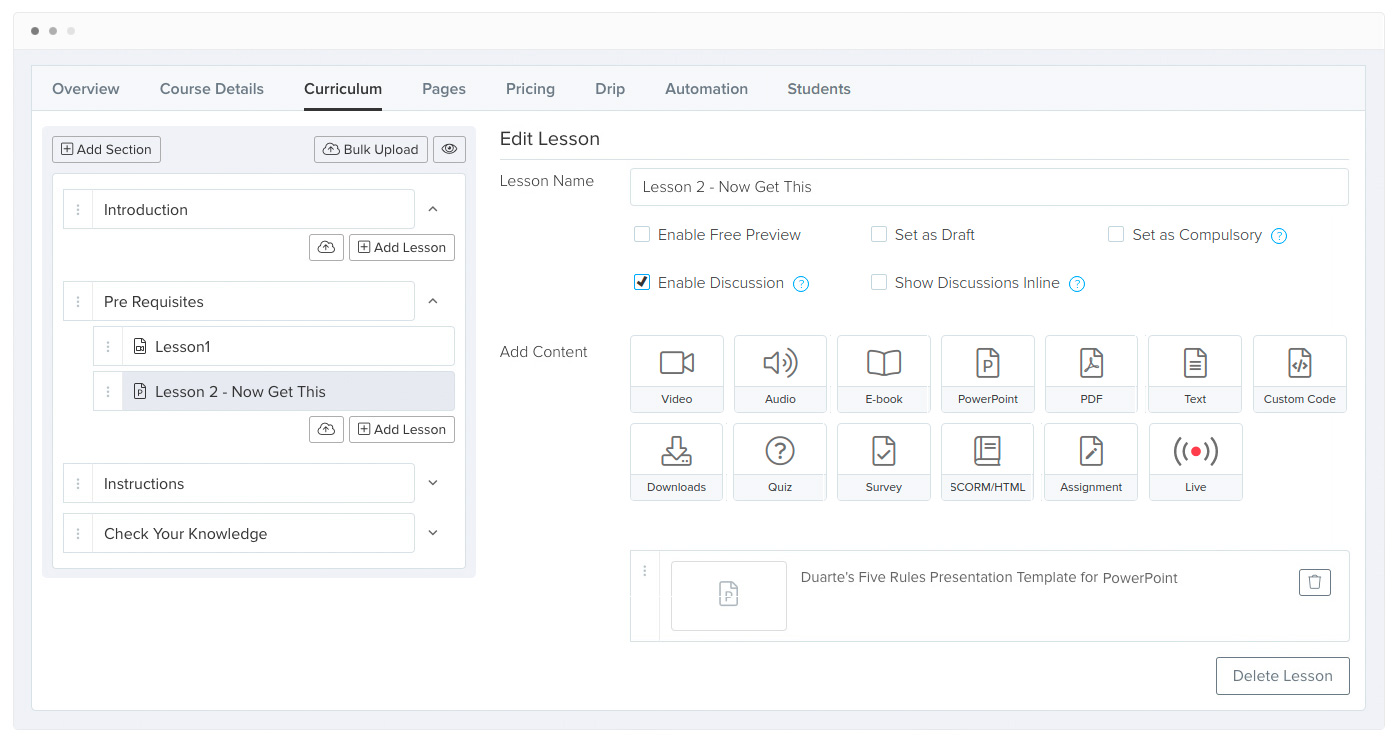
Let’s get started, open either from the Zenler Icon or from PowerPoint. Once in go to the Zenler Studio Tab in PowerPoint and look to the far left and you will see the Course Icon. Click on it and you will be given the options to start a new course, open a previous course or select from a list of recent courses that have been worked on. So from here let’s create an e-learning course from an existing PowerPoint presentation want to use.

To create our course we’ll use the “Blank Course” option, title it and save it. From here click on the import icon and select the PPT file you want to use and it will appear on the right. You can now import all of your slides from your presentation, put them all in one chapter or break them up into separate chapters. To import the slides just click once on the ones you want to import, it is that simple!

Now that we have our slides open in on the right just select the ones you want to import and click on them and they will be placed in the chapter you are working on.

Just continue this process to add more slides and if there are more chapters then just add a chapter and use the same process.

Importing Word Documents

To import a word document just select Word Document in the Import Icon and then select the document you want to import. You will be given a choice of importing the word document in either standard letter adjustable within the slide or as a Flip Book for page turning. Just click OK and you are done.


Tips & Tricks

Recap of Learning Technologies Expo 2012

Last week Zenler exhibited at Learning Technologies 2012 UK at Olympia 2 in London this week past and we were very encouraged by the turnout and by the reception we received. Most of the attendees were from the UK however there was a good representation from the rest of Europe as well as Asia and the Middle East. Many were delighted with our product offering and we were amazed that many were pulling out their credit cards ready to buy! This was remarkable and after all the work we put into Zenler Studio and Zenler Online in 2011 to say we were glad to hear this reaction is a understatement. We can attribute this reaction to our visitor’s current issues as well as the uniqueness of Zenler’s offerings.

First of all there are a lot of people out there still using PowerPoint for all their course development whether in the classroom, instructor lead over the internet or for e-learning. Our visitors were thrilled to see how easy Zenler Studio made it to transform their current PPT files to a publishable e-Learning format to most any LMS Format. Many had looked at and tried others products and Zenler Studio was in many people’s mind the easiest and most intuitive to learn and would have them up and running fast. We had a lot of inquires about how to Gamify eLearning in no time and when people saw how easy it was to create scenarios and games to enhance and transform their audience’s learning experience they were again asking if we could take payment right there! Zenler Studio Pro with Games Beta version is due to release shortly so stay tuned.

Our reengineered Quiz Maker was a big hit, most of our guests liked the flexibility and the speed with which they could compose a quiz along with the customization that could be done with it. They also liked the reporting that was done at the end of every quiz and the final quiz. Flexibility and speed was a common statement we heard from our visitors with many using comparisons to other products they use, tried, or were looking at. For instance, our screen capture function in Standard and Pro you have the option of several screen captures to choose from and once the choice is made the directions for beginning and ending the function are given to you before beginning and they liked that!  Our design philosophy was to create a Straightforward, easy to learn and easy to use series of E-Learning tools and from the reactions we heard we feel our initial efforts were successful, but we will always seek to improve, our customers need and demand it!

Our HTML5 mobile offering got some attention as did the courses we demonstrate on iPad’s. Our HTML5 module will be out soon and is an add-on for all the Zenler Studio series. Soon whether it is in the Tube, at lunch or while at home your trainee will be able to get the courses they need at their convenience. Our On Demand LMS, Zenler Online rounded out our offering and was a real hit with those who are looking for a change or just beginning, again the quality and ease of use with the flexibility and reasonable pricing turned heads!

Over the past year Zenler has worked to develop a company that can provide cutting edge tools for the e-learning community. Our goal has been to give those just beginning their e-Learning adventure an affordable means to begin and the depth of product line and a company they can grow with. Our desire is to be our customer’s partner helping them deliver value to their enterprise whether it is the small snack shop down the street or a global logistics provider with 100,000 employees we will be there, the response we received at LT12UK proved we can do it!

As a side note, this was the writer’s first time in London and my wife and I found the people extremely friendly and courteous. The pace of London was to our liking even though we did have some misadventures on the tube! Bangers and Mash was a big hit as well as the Full Monty breakfasts and of course the pubs!!! By the end of our stay we were sad to leave but cannot wait to return. We have been many places across the globe but both Ivy and I agree London and its people will always stand out in our memories.

Zenler Team

Learning Technologies 2012 at Olympia 2 in London

Wednesday the 25th of January Zenler will be exhibiting at Learning Technologies 2012 at Olympia 2 in London and we’re having to hold back out enthusiasm for that day to arrive. Zenler will be showing our new line up of authoring tools, On Demand LMS and our alpha version of HTML5 Zenler Studio E-learning capabilities.

First off we will have Zenler Studio Lite which is designed for those starting out in the world of e-Learning. ZSL’s mission is to produce courses with interactivity, audio narration, and quiz capabilities to produce engaging courses at a very affordable price. The novice or the pro thinking of striking out on their own or the organization who wants to craft their own training programs can do so with a tool that will meet the task at hand and be ridiculously affordable.

Zenler Studio Standard edition is ZSL on Steroids!  Along with a greater selection of interactivities that can include videos within the interactivity ZSS now has video and voice narration, and the ability to access YouTube videos inside a slide. Like ZSL it is very economically priced and as easy to use as ZSL.

Zenler Studio Pro is the full weight of Zenler Technology behind it. ZSP has everything that ZSS plus all the course templates in our inventory, 10 interactivities, a broad selection of quiz templates and the ability to import slides from MS PowerPoint and MS Word Documents in Flash. As with all our authoring tools you will be able to produce rich engaging courses almost out of the box. And we are not done yet, Zenler Studio Pro has a Game Based Learning edition as well! Zenler Studio Pro+ with GBL.

We will also be demonstrating our Alpha version of our HTML5 program with some sample courses from Zenler Studio on iPad. Please come by and give us your opinion. By the way all the Zenler Studio’s will be able to produce course in HTML5.

So you can see why we cannot wait for next Wednesday to roll around! We are in booth 41 just by the escalators, you can’t miss us. So from all of us at Team Zenler, we look forward to seeing you there!!!

Zenler Team

Learn to connect the dots

It is over three months since the passing of Apple’s Iconic leader Steve Jobs. There have been many things written about him and I am certain as we look for and analyze the secrets of his success there will be much more written. I will not pretend to have any special insights but in sticking with our most recent themes I will attempt to explore Steve Jobs creativity. Was Steve Jobs a creative genius or was he a guy who knew how to really jam? As Picasso impacted the art world so did Steve Jobs impact our day to day lives and lead an industry, but was he creative and if so how?

Looking at some history we see that the Graphic Viewer Interface and the Mouse that made the McIntosh such a game changer was developed at Xerox and not at Apple. IPod was in response to the clunky or small and useless digital media players of the day, when it was introduced critics screamed at the $400 price tag and the odd circular touch controls but they would hold 1,000 songs and you could download all your CD’s or buy individual songs for 99 cents. The name was inspired by the Line, “Open the pod bay door Hal” from 2001: A Space Odyssey and was incorporated by a freelance copywriter on contract with Apple specifically to introduce IPod to the market. That is not original but possibly creative but not Steve’s idea. IPad was pulled out of development because they saw that IPhone was going to be the next step and iPhone’s success was really driven by really low or no cost apps that were from developers outside of Apple. Of course some of this was planned but how much and was it creative or really just getting on a rodeo bull and hanging on?

Was Jobs working on the engineering of these products? Not really, in one quote he states his job was to “provide and protect the environment where people can be creative.” And of course he had several design and engineering groups all over Apple and he oversaw the whole enterprise and was reputed as a bit of a Micro Manager. As with most CEO’s Steve drove the vision of the company and its products and even more so he drove his customers wild. He once said, “If you design and build what the customer wants today they will probably want something else tomorrow.” So you definitely have to look down the pike and this is what I believe maybe the source of his creativity. “I skate to where the puck is going to be, not where it has been.” said Wayne Gretzky and Jobs lead Apple with this philosophy.

So how did he do this how did he take Apple where others had not been before? “You can’t connect the dots looking forward; you can only connect them looking backwards. So you have to trust that the dots will somehow connect in your future. You have to trust in something – your gut, destiny, life, karma, whatever. This approach has never let me down, and it has made all the difference in my life.” And this approach seems a bit capricious doesn’t it? If you have ever done business projection you know the “dots” in the past point to the “dots” out there in the future. And if you look at current trends and market forces etc. you have data that will help you tweak where the future “dots” will appear. These are the norm for business practices and what most of us will follow but Steve was different, he didn’t march with the heard. On the map with all the “dots’ past and future Steve probably saw where the heard was going, where convention dictated and what was a prudent course and maybe he asked, “What if?” I think Steve saw a different path and only looked at his “dots” verses the heard. And he took others ideas and improved on them. Simon was the first smart phone introduced in1992 by IBM. Palm Pilot put your contact database in your hand they had a phone soon after. Steve didn’t like the stylus’ he felt that we already had one called a finger and that little philosophical idea aka, “dot” made all the difference with the iPod, iPhone and naturally the iPad. Not a big difference.

It is said if you drove a straight line from New York to San Francisco it is about 3000 miles. Move the steering wheel 1/8th on an inch to the left and you’re in Mexico. Just a little bit not much will cause such a radical change. I think Steve at times could see that that 1/8 of an inch would take them far from convention and either saw or trusted that the ‘dots” would be there and he was right. One “dot” he learned from another “Creative” marketer from the world of golf, Ely Callaway. When Ely introduced the Big Bertha Driver it was revolutionary in design. Most everyone thought this new design would be priced at a few dollars above the rest of the pack and that it would fail soon, Ely didn’t do that. He priced the Big Bertha not $20 but $200 over the competitions price and they flew out of the stores! The same thing happened with the “i” product line for Steve. Both products weren’t really radically different but they were different none the less but perception drove them further and taking the risk to go against the tendency to price product as low as possible definitely bucks the norm and that is marketing creativity and daring at its finest!

In his later years Steve was more about facilitating others creativity and he found his creative path as a visionary and leader. “Technology is nothing. What’s important is that you have a faith in people, that they’re basically good and smart, and if you give them tools, they’ll do wonderful things with them.” His goal was to facilitate the atmosphere where others in Apple could be able to be creative without restraints. Yes he was known for micromanaging a bit but I am certain the engineers and designers were stressed to “get er done” vs. worrying about budgets. He moved the “dots” within Apple very well. He was also very grounded in a reality many of us do not want to face, our own mortality and what it means, “For the past 33 years, I have looked in the mirror every morning and asked myself: ‘If today were the last day of my life, would I want to do what I am about to do today?’ And whenever the answer has been ‘No’ for too many days in a row, I know I need to change something.” From this we can gather that much of what he did was based more on what he liked to do vs. what he had to do. The results of this may be seen here, “Innovation has nothing to do with how many R & D dollars you have. When Apple came up with the Mac, IBM was spending at least 100 times more on R & D. It’s not about money. It’s about the people you have, how you’re led, and how much you get it.” And from the desire to do what he liked Steve and his company gave us the innovations that have changed the world. And maybe Steve did like out running the big guys R & D departments in those earlier days too!

All of us involved in e-Learning are in one way shape or form one of Steve’s “dots”! Steve predicted that “Computers and Software will change how we learn” and all of us are the ones doing this now. Let’s look at it this way we’re all like the engineers and scientists who responded to the challenge laid down by John F. Kennedy, “I believe that this nation should commit itself to achieving the goal, before this decade is out, of landing a man on the moon and returning him safely to the earth.” During that era we were discovering and learning new things at a fast pace that has not stopped accelerating. I remember a projection form 1983 that what we knew then would be only 17% of the knowledge we would have by 2000. That is staggering when you think about and the demands to stay current are demanding on our audience, the learner and on those who must design courses and everybody needs to try and keep up! In some areas the content being taught is becoming obsolete by the time the courses are finished and to the other extreme we are stressed to find anything new since the knowledge base has been static for 40 years or more. Both situations take imagination and creativity to either engage or just plain keep up! So now we must learn to create at a rapid pace because those who are learning have to learn at a rapid pace just to keep up. The demands are high and the challenge is to be creative and “go where no “dot” has gone before”, forgive the Star Trek parody.

Creating new and invigorating learning experiences for our clients who are learning just to keep pace with all the changes that are taking place is a demanding enough task. We learn from Steve Jobs’ example that if we follow the “dots” from the past logically we could be in trouble. We need to think with more creativity and daring to insure our future. Now more than ever is when we need thinkers and doers with the audacity of a Steve Jobs to help us explore just where e-Learning, M-Learning, GBL etc. can take us. All of us are on the cutting edge of what Steve and others like him saw years ago. I for one look forward to facing the challenge before us all. How about you?

Tips & Tricks

Rebel with a Cause

Continuing on with the theme of creativity is important and it is needed since we are so conditioned otherwise. Think about it, we are very creative when we were little. We had finger painting and wild stories of imaginary heroes and heroines overcoming villains that were larger than life. A pillow case becomes a cape and we are jumping on the bed pretending to fly. One friend of mine went out a 2nd story window on more than one occasion! Our Mom and Dad became stick people and lived in houses that were architecturally unsound but were magnificent works of art for a 5 year old. Stick drawings of our sister had purple hair and green skin! This was raw unbridled creativity at its best. Our minds were free to wander and wonder. So what happened?

We all know, we went from K through 12 and learned we had to become adults and follow systems. Systems of government, Social order, Mathematical, Language and Scientific systems. Free thought was encouraged just as long as it was along the lines directed and you stayed within constraints. Our creative nature is bound up hog tied and put in a box. You see creativity has an element of rebellion to it and that cannot be tolerated. Something that is not in the status quo is considered well a bit weird, nuts or disobedient. All children are artists. The problem is how to remain an artist once they grow up.  In the world of modern art there was one rebel I saw recently and wanted to share with you Pablo Picasso was a rebel and he changed how we looked at art forever. Come with me for a few moments and watch the old rebel create on glass, it is mesmerizing: http://www.youtube.com/watch?v=ow7eEWh37iU It will be interesting to see what you think about this short video, the man and his art. It was interesting to watch how he took simple lines and used them to create an image. His expression and demeanor through the process was intriguing to me, of course the music helped too! He was definitely a game changer and his Nude, Green Leaves and Bust painting went at auction not too long ago for $106.5 million reputedly the highest priced painting sold at auction ever, all because he broke the rules!

So what led to his success and influence? The attitude that he would live as long as he could create leads us to believe that he had really found his passion in art. But it seems he was trying to get back to something he felt he had lost when he said, “It took me four years to paint like Raphael, but a lifetime to paint like a child.” He was it seems constantly fighting constraints imposed on him and continued this throughout his life.. I found it interesting to learn he was a son of an artist who was an art teacher and Picasso attended 1 year of Art College but dropped out and went his own way. “I am always doing that which I cannot do, in order that I may learn how to do it” shows he was always challenging himself to explore new things and the constraints of Art School proved too much. In art all sorts of options exist but when you are composing an e-course for proper crankshaft mounting techniques or how to handle upset customers being creative can be a bit more challenging than painting on glass. Or can it? Granted, crankshaft installation has some set rules but is how we teach it limited by that? I don’t think so! We can use various images to relate the content and develop a game with say small people doing the assembly work similar to the Egyptians building the Pyramids. Our how about a scenario like the movie “Meet Dave” where small aliens operated Eddy Murphy, we could have our own Eddy operated by Alien Mechanics. That is weird, but why not? If the student learns all the steps and they are engaged and maybe entertained it gets the point across. And let’s face it, it’s not boring! We may want to avoid having a Picassoesque crankshaft being installed since it may not be physically possible. The point is let go and create something different and if it engages you and those on your team it just may engage your learning audience and create a memorable and beneficial learning experience with something that sticks with them. And when they are 56 years old and installing a crankshaft they may just smile and remember those small Alien mechanics. For me, I remember the physics lesson on inertia from running two girls on skateboards into each other and that was a long time ago, believe me but it is a very fond memory but more important, a lesson have never forgotten.

Picasso stretched and pushed convention out of the way and created art we will never forget. We and I speak for Zenler now will never shake the world like Picasso did, but we all can follow Picasso’s lead and at least attempt things we cannot do and in doing learn. Being creative or creativity has several elements to it but what I see is passion, desire, rebellion, childishness or child likeness, and maybe a bit of insanity and the willingness to risk going to these areas verses just following the pattern. I’ll end with a short story, a mother and her daughter were cooking a ham for the holidays and as the mother cut the tip of the ham off and threw it away. Her daughter asked her why and her mom told her that her mother had done this. The young daughter persisted with why; you know how kids can be. So she called her mom and asked the question and she said that that is how her mother baked a ham. So they all called great grandma and asked her and she told them she did so because it was too big for the baking pan she had!

So sometimes we hold to the status quo and don’t even know why! Thank goodness there are Picassos who come along who challenge and inspire us to look at things differently and who have the tenacity to go against convention and break, heck throw out the rules and in doing so show us how liberating being creative can be.

Tips & Tricks

Zenler at Learning Technologies 2012

We are exhibiting at Learning Technologies Expo 2012. Visitors will be able to learn more about the Zenler offered by DigitalOfficePro and able to take a closer look at the new feature of Zenler. Visit us at the Zenler booth #41, Learning Technologies Expo 2012 (January 25-26, 2012) at Olympia 2 London. Nothing like you has ever seen before.

The Learning Technologies exhibition, now in its 13th year, is Europe’s leading showcase of organisational learning and the technology used to support learning at work. And it continues to grow in importance, value and attendance year on year.

Technology supported learning and the role of the learning and development professional has changed dramatically since the launch of Learning Technologies over a decade ago, and employers need to ensure that their staff has the skills and knowledge to continuously adapt to the changing needs and demands of their organisation.

See you at Zenler Booth #41 …

http://www.learningtechnologies.co.uk

Zenler Team

Get Creative or don’t be Boring

The story on Einstein and the painting say a little bit on how one of our greatest minds looked at his work and it revealed a little of the man behind the myth. And when we look at Einstein further I can hear the faint cry, “be Creative” in the distance. Another saying I have held close of Einstein’s is the one he had stated when questioned on whether or not his work would disprove the existence of God, he responded, “My mission is not to disprove God’s existence but to discover the wonder of His creation.” So as we are pursuing our mission we hear that faint cry, “be Creative” too!

Creativity, I look at it in the world of learning as how we address presenting the content for the learner to assimilate it into their lives. The old maxim of “the Mind can absorb only what the fanny can endure” can be taken literally, but really it translates to boredom doesn’t it? Engagement is the war cry and boredom is the enemy. So to eliminate boredom, or extend fanny time we need to design learning experiences that are less boring. So where do we go to learn to not be boring I’m sorry, to be Creative? Can we even learn to be creative?

I always associate creativity with the arts; music, paintings sculpture, you know art, where all the really creative people are. Well we saw that Einstein looked at his work like an artist seeing his work in some contexts as a picture. So if we think of creative people as being in the arts then why not look there. Myself, I have played guitar in a band and when you play the same thing over and over again night after night for years that is not creative it is work! And we had to do it because we were hired to get people up on a dance floor and get them moving etc. So when did we ever have a chance to get creative? Jam Sessions! From time to time we would have some time to just play around or have some friends over, if they were near us and just goof around. Since we were not performing and did not have to entertain or engage an audience we could mess around and be creative. We’d take a chord progression and just play and every one would do an impromptu solo.

Really this is a simple act to pull off all you need to know is the key you are playing in and some scales and there are all sorts of standard melodic progressions (AKA Licks) to play with and then all it is, is piecing them all together on the fly. Fun! No longer boring because you don’t know what you’ll do next but the odds are you have already done it before, just not in this key or with this rhythm. The neat thing is that you learn a little and next time you are playing the same song night after night there maybe something you take away with you from the Jam Session to incorporate in that tune. By the time we finished several years on the road the Doobie Brother’s Long Train Running didn’t sound anything like the record as did most of what we did, except for Shake Your Booty by KC and the Sunshine band! Yea we had to play that! The point is we already knew the things we  would use but due to the environment we were in and the fact we were there for fun it just flowed.

So how does this effect what we are doing today? As we go through our daily routine we look for the times we can “Jam” and add a little bit of something we have already done before but maybe use a different video, or new art work and maybe we take some liberty with the content and change the rhyme and meter yet say the same thing. We could ask some silly questions on a quiz or have an interactivity that takes a student to a different place than expected. We throw in the uniqueness of who we are and press the envelop a little. And when we have to come back and play the same songs again we can add a little something that will make it our own and we may have created something that is easier on the fanny, not boring or maybe even creative. Our slogan is “Zenler the art of interactive e-Learning” and we are pursuing our craft with the passion and focus of, well maybe not Einstein, but let’s say an Eric Clapton, Yo Yo Ma, Carlos Santana, J. K. Rowling or even a JRR Tolkien. Now we’re jamming!!!

Tips & Tricks

The Art Of Vision

On our logo we have the phrase “Zenler, The art to interactive eLearning.” Often I’ll take a look at that and wonder, “So where is the art here?” “We are systems and software guys teamed with educators and trainers, so where is the art?” As I was pondering this I thought back to an evening a long time ago at a local gym that I had a membership at with all the spa accoutrements including a great Jacuzzi. It was in this setting that I learned about someone who’d I’d have never thought of as an Artist.

As usual I was speaking with a friend on some current issues and quoted a saying of Einstein’s “Perfection of means and confusion of ends is the ailment of our times.” From across the Jacuzzi I heard someone say, “Albert Einstein”; it came from a man obviously in his early to mid sixties. We invited him to join our discussion and what we heard has never left me.

Dr. Ben is how I will refer to him here held a PhD in Chemistry, Physics and was an Episcopal Canon and head master of a local private K-12 school. He was a graduate of the University of Tennessee and spent his first working years in Oak Ridge working with Heir Doctor, which is how he referred to Einstein. With my education in physics the conversation intrigued me immensely and so did the fact that Dr. Ben revealed that Heir Doctor didn’t like mathematics but it was the language he was forced to use to work at his craft. Dr. Ben knew this since in the last 3 years he worked with Heir Doctor he kept his phone book and balanced his checkbook for him. WOW!!! He was challenged with numbers? So was I, I could do a calculus equation but often messed it up when I had to plug in the numbers, Heir Doctor had the same problem, I was in good company!!!

Dr. Ben then related to me how Heir Doctor actually thought and did so through a story which I’ll tell you now. In that day, 1949 Einstein and those closing in on his IQ would use rooms full of PhD’s just out of school to do the grunt work for them. They would put 6 to 10 guys in a portable building like what we had in school here and they would have desks or share tables and three of the four walls were covered with chalkboards where they would work out the problems laid out for them by Heir Doctor.

One day they all felt that they had worked through the problem thoroughly and were ready to present the solution to Einstein. When he came in they all stood proud knowing they had solved a key element that would allow the overall project to move forward. Dr. Ben told me of how they waited as Heir Doctor walked around the room looking at the massive equation that took 3 6 day weeks and 6 PhD’s to work through.

After just 5 minute Einstein turned around and said “It will not work!” They were shocked and very upset and let him know it, “With all respect Heir Doctor there are six of us here, all tops in our class and all with Doctoral degrees and we concur that our solution is right! Frankly sir how can you in just 5 minutes determine that it won’t work?”  They were all insulted but the next comments were what Dr. Ben wanted to related to me.

Einstein replied, “Look at this as painting gentlemen; a nice pastoral scene with green flowing hills and a stream running through the middle of it. There is a young boy pushing his sister on a swing in a tree as their parents are preparing a picnic. Down the hill is a small calf by its mother as she eats. Flowers are beginning to bloom and sway in what must be a gentle spring breeze.”  They all were wondering “So?” He continued, “The stream was moving and the waters were channeled by the rocky bed with stones protruding through the surface” with eyes closed, “you can almost hear it gentlemen.” Then he opened his eyes and issued a challenge, “but in this scene gentlemen” pointing to the blackboards, “we have a beer can sitting in the stream rusting.” (They were made of steel back then) “And gentlemen your rusty beer can is over in that corner of the room.” Pointing the far right corner. He turned and grabbed his hat and coat said good bye and to call him when they had the solution and left. It was 3 days later that they found the error which was minute.

The point that Dr. Ben made afterwards was that Heir Doctor was really a romantic at heart and had an artist’s soul. In one of his quotes Einstein stated, “My mission is not to disprove God but to discover the beauty and wonders of His creation.”

In tackling the complex problems before him he envisioned the solution not as an equation but as a painting or a picture. Never would I have thought that Einstein would have such a thought process, I’d always thought of him immersed in complex equations but instead he was a dreamer with the passionate soul of an artist!

Over the years we knew each other Dr. Ben and I spoke more about this story and others about Heir Doctor, how his passion was evident in the vision he had for the work he was doing. And he also made me aware of how he had challenged some very bright and accomplished young men using his artistic vision.

So, “The Art of Interactive eLearning” is for us at Zenler something that comes from the heart. But really, as we progress in to the world of GBL we are looking for users of our products who have a passion and the vision to practice their Art and Craft with the vision of Einstein!


Tips & Tricks

Mobile eLearning Just Got More Affordable

There is a lot of buzz around Mobile Learning aka, mLearning, however the adoption of mLearning among organizations hasn’t been something that matches this buzz.

iPhone and iPad really sparked the idea of mLearning but the high cost of the hardware and Apples lack of support for Flash on their mobile devices has limited the progress with developers having to totally revamp their products for iPhone & iPad use for mLearning. Add to this the confusion regarding whether to go the vendor specific App route or use HTML5 – HTML5 as an evolving standard, support for HTML5 across browsers. The other Android based iPad competitors have not delivered and their price points are still a bit too high for those looking to adopt mLearning and it leaves the general consumer with the question, “Why not spend just a bit more and get an iPad?”

Amazon uses its massive cloud EC2 infrastructure to deliver content to it. In fact our ZenlerOnline LMS platform itself is built on Amazon Cloud/EC2 infrastructure and this provides us with great scalability. Kindle Fire includes a powerful browser Amazon Silk. Silk is a split browser that partially lives in Amazon’s EC2 cloud and partially lives in the Kindle Fire. This gives Amazon the upper hand when compared to Apple as if it works seamlessly as claimed, the users will get the advantage of  the massive computational processing power of EC2 to speed up Web browsing, a challenge for most mobile devices. This helps optimize and deliver Flash files, videos and web pages faster. This helps in streaming e-learning content faster and even play complex game based learning content faster. What does this mean for those of us in the mLearning field?

In corporate America there is no doubt that good training can give a good ROI and logic only dictates that mLearning will enhance the ROI for training employees. But with developers scrambling to get up to speed without Flash and to deal with HTML5 the vast library of content is restricted dramatically. Then add to this $499 and chances for ROI are limited. Enter Amazon Kindle Fire, opening up the access to all the available learning content, making it mobile and cutting the hardware cost by $300, that’s 60% OFF! Now a good ROI is in reach and management may just give the green light to adopt mLearning for real, the game is changed! And let’s not forget that many high school and college students can now afford a tablet where as they may not have been able to afford a laptop. Add to this the ability for colleges to deploy mobile learning to the existing work force for continued education while on the go and there are some other game changing advantages present.

We are waiting to see how private and public organizations react to this development; Amazon may have really opened up some interesting options for all of us who want to get the Mobile E-Learning field moving faster. Will it help turbo charge our efforts and deliver the goods or will it be more like the other Android based tablets like HP’s Xoom that were less than stellar? The technology seems to be there and the key is the price is right, all we can do now is wait, have you pre-ordered yours yet?

Tips & Tricks

Thoughtful Game Based Learning Design

The missiles were flying in with devastating accuracy and the cannon fire wasn’t any less devastating. There seemed like there was nowhere to turn or run and hide. It was either flee by foot in the desert or die. The Zenler Daily article on “Thinking Like a Game Developer” (http://bit.ly/nEEjyz & http://bit.ly/prdewt) took me back to a night back in 1991 when I was at an Air Force Association meeting in Melbourne, Florida. The room was dark and a video was playing with no sound. What we were watching was the recording of Joint Surveillance Target Attack Radar System (Joint STARS) involvement in the air and ground attack on Kuwait City. Although it looked like a really advanced version of Asteroids it most certainly was no game!

What we saw that night were the actual images as seen on the CRT in the Joint STARS aircraft as the battle had happened. X’s and O’s with the X’s being coalition forces and the O’s were the Iraqi ground forces and looters. X’s  that were planes were swooping in rapidly from the Northeast and slowly plodding X’s coming from the south and enveloping the O’s were tanks and personnel carriers. X’s were also approaching from the southeast slowly through Kuwait city with all O’s headed for the main artery out of the city. It was very sobering to watch as an O would stop and then disappear. Later we saw photographs of the aftermath of this onslaught, it was deemed “The Highway of Death” and the “Mother of all Retreats” it was devastating and it wasn’t a game. But some would consider that it was games that trained the personnel behind the X’s, obviously the O’s didn’t have this advantage.

The scenario we had seen had been taught, simulated, and rehearsed countless times before any of the events we saw took place and had the 3 elements Karl Kapp had mentioned; starting with a challenge, focus on replayability and include a story narrative. They had a desired outcome and stream of events that needed to happen to achieve it, sounds like the challenge and the narrative together, in this case it was called a battle plan or plan of attack.. The training had to be replayable with feedback available immediately so the adjustments could be made before lives were put on the line. This was done in Tank, Aircraft, and manned vehicle simulators prior as well as the field exercises and briefings at all levels. They were well trained and ready for the “Organized Chaos” of battle.

Fast forward to just about 2 years ago I was in a local simulator company who has a system that has a large 270 degree simulation screen where combat troops can participate with tank crews, F/A 18, A-10, Navy Missile and/or Helicopter crews in a battle simulations in real time from different facilities next door or across the country. This now gives command the ability to design and refine training for specific missions utilizing all the assets needed, in simulation training across disciplines and services. The impact of this is huge! Through replaying and evaluating performance they can adjust before they enter the situation LIVE to increase their chances of success and decrease loses. It is a great return on investment for certain. In the case of combat game based training attaining engagement is really easy since the stakes are high. In our venue the challenge is to engage our audience with content that is not necessarily as exciting as a battle scenario. How do you come up with a game that will address the issues of sustaining a factory’s production output? Or “Boldly go where no one has gone before” in proper boiler maintenance for large buildings, and “Leap tall equations” in 6th grade Algebra? Making these and other such topics engaging and exciting are the challenge so all we need now is a narrative that will replay and we will have followed Karl’s lead! So let’s get busy!

Tips & Tricks